Nikolai Usack Answers 3 Common Questions about Income|Outcome’s Approach to Financial Training
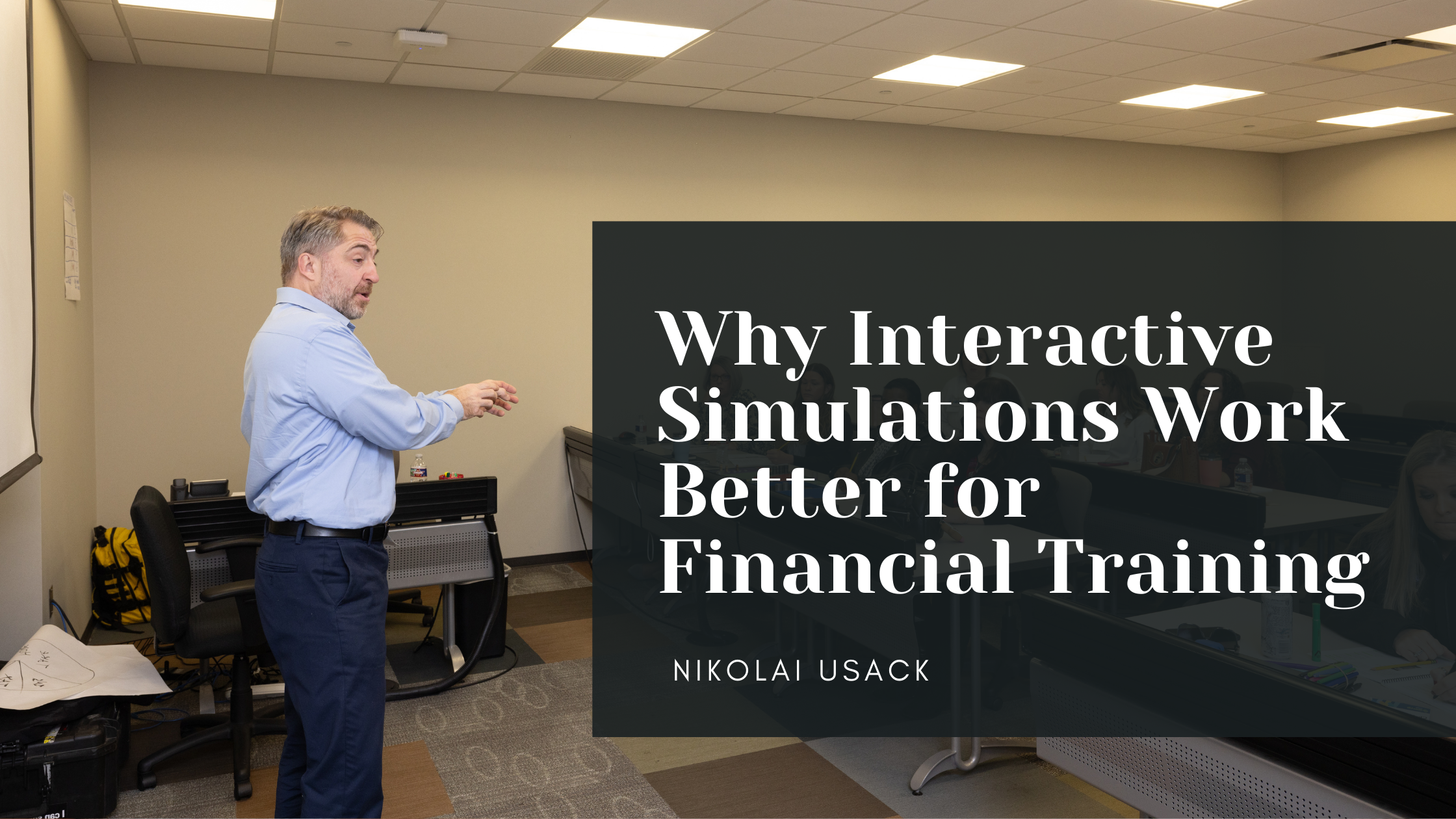

Nikolai Usack
Published Date
Real-World Learning That Produces Real Results
If your employees groan when they hear "financial training," you're not alone. Traditional financial literacy programs rely on lectures, dense workbooks, and static materials that people forget within days.Why does this happen? Because traditional approaches to financial training don't engage people in meaningful ways. Employees tune out, retention suffers, and organizations see zero ROI on their training investment.
What if financial training didn't have to be boring?
Income|Outcome takes a radically different approach: hands-on training approach that eliminates passive learning entirely. No slides. No lectures. Just hands-on experience where participants make real business decisions and immediately see the financial consequences.
Over 100,000 professionals worldwide have discovered that the best way to learn finance isn't through PowerPoint—it's through doing.
The Limits of Lecture-Based Training
Traditional Training Approaches Fall Short
Traditional financial literacy training follows a predictable pattern:
- Facilitator advances through 50+ slides
- Participants struggle to stay engaged
- Complex concepts are explained but not experienced
- Everyone forgets most of it within 72 hours
Research on adult learning shows that people retain only 5-10% of information from lectures, compared to 75% from practice-by-doing and 90% from teaching others or immediate application. When you need employees to actually apply financial knowledge on the job, PowerPoint presentations simply don't cut it.
The Simulation Solution
Income|Outcome replaces slides with experiential learning:
- Participants are actively engaged from minute one
- Teams make decisions and see financial results in real-time
- No passive listening—every moment requires critical thinking
- Learning happens through struggle and discovery, not memorization
When participants walk into an Income|Outcome workshop, the simulation doesn't include lectures or slides. Instead, they find themselves running a company, making strategic decisions about pricing, capacity, market positioning, and cash flow management.
The difference in engagement—and retention—is immediate.
What Makes This Business Simulation Different?
It's Not a Glorified Board Game
You might be skeptical. A board game for business finance? Sounds too simple, right?
Wrong.
This isn't Monopoly for the workplace. Income|Outcome is a sophisticated business acumen simulation used by Fortune 500 companies and top-tier business schools worldwide.
Over 100,000 professionals have experienced Income|Outcome, and it's available in 12 languages for in-person workshops (plus customization for any language online).
It's Low-Tech, High-Touch
There's no element of chance in Income|Outcome—no dice, no random cards. Every result is entirely driven by the decisions teams make. This creates a direct cause-and-effect relationship that mirrors real business environments.
Almost immediately, participants begin connecting what happens in the simulation to what happens in their real jobs. They discover that financial literacy isn't just a useful skill—it's a competitive advantage that makes them more valuable to their organization.
Traditional Financial Training vs. Simulation-Based Learning
Why Interactive Financial Literacy Training Is More Effective
The Psychology of Experiential Learning
Initiating real change is always a challenge. Even when employees are open to learning, they're busy—and attention spans during traditional training are short. Even when they pay attention, retention rates are low.
We believe that a little bit of struggle leads to real learning. Think about the life lessons that have stuck with you the most—chances are, they came from challenging experiences rather than passive learning.
Think back to your first few weeks at a new job:
- You had to adapt quickly, learning company culture, processes, and terminology on the fly
- You were intrinsically motivated to absorb information because success depended on it
- The pressure forced you to learn rapidly—and you remember those lessons years later
Income|Outcome uses the same psychological principle by creating a controlled environment where participants experience business challenges firsthand. The struggle is real—but the consequences are not.
A Safe Place to Fail
In the simulation, a team can completely crash their company—run out of cash, lose market share, make catastrophic pricing decisions—but unlike in real life, no one loses their job.
This is exactly why the learning is so powerful. In a real business, mistakes can be costly or irreversible. But in a business simulation, failure leads to insight rather than consequences.
Much like a flight simulator prepares pilots for emergency situations they hope never to face, Income|Outcome creates an experiential learning environment where teams can make huge mistakes and learn from them—without the high-stakes consequences of reality.
The "aha moments" that come from these failures? Those stick. Participants remember the quarter they nearly went bankrupt because they didn't manage working capital. They remember watching competitors take market share because they underpriced. They remember the financial principles because they felt the consequences.
A classroom presentation cannot create that kind of memorable learning experience.
Frequently Asked Questions About Hands-On Financial Training
How do simulations teach complex financial concepts so effectively?
Lecture-based training creates passive audiences.. Income|Outcome creates active decision-makers.
Instead of explaining what happens when you extend too much credit or over-invest in capacity, participants experience it. They see their cash position deteriorate. They watch competitors gain ground. They face the consequences of their decisions in real-time—and they remember those lessons because they felt them.
This isn't theoretical knowledge—it's practical wisdom gained through experience.
Don't people need slides to reference later?
Traditional training relies on slides because participants need to "study" the material after the session ends. With simulation-based learning, participants master concepts during the experience itself.
Income|Outcome participants don't need slide decks to remember financial principles—they remember the moment their team nearly went bankrupt. They remember the quarter they dominated the market by understanding competitive positioning. They remember the debates with teammates about whether to invest in capacity or preserve cash.
Experience creates retention that no slide deck can match.
Is hands-on financial training really more effective than lectures?
The data is clear. Studies on experiential learning consistently show higher retention rates, faster skill application, and better long-term outcomes compared to traditional lecture-based training.
At Income|Outcome, we've trained over 100,000 professionals at companies like Michelin (a 30-year client), Hewlett-Packard, and Abbott Labs. These organizations don't invest in simulation training because it's novel—they invest because it works.
When a team fails in the simulation, is it still worthwhile?
Absolutely. Some of the most powerful learning happens when teams fail spectacularly.
The beauty of simulation-based training is that failure is not only safe—it's often the best teacher. When a team runs out of cash or loses market dominance, they immediately understand the financial principles at play. Those lessons stick far longer than any bullet point on a slide ever could.
What Participants Say About Simulation-Based Training
Participants tell us all the time:
💬 "This is the best financial training I've ever had."
💬 "Every organization needs this tool."
💬 "I finally understand how all the pieces fit together."
Why? Because it works.
Income|Outcome de-mystifies finance and gives participants the language and confidence to engage in high-level business conversations. They stop seeing finance as a mysterious department full of number-crunchers who make life harder—and start seeing it as a strategic tool they can use to drive better business decisions.
Whether you need to teach basic financial literacy to frontline managers or equip your senior sales team to navigate global markets, Income|Outcome transforms the way your organization approaches finance training.
Who Benefits from experiential learning?
Manufacturing Companies
Teams learn how capacity decisions, quality investments, and pricing strategies impact financial performance—using scenarios directly relevant to manufacturing operations.
Retail Organizations
Participants see how inventory management, pricing strategy, and market positioning drive profitability—no generic examples, just retail-specific applications.
Professional Services Firms
Employees understand how utilization rates, project pricing, and resource allocation affect the bottom line—tailored for service-based business models.
Academic Programs
Business schools use Income|Outcome to give MBA students hands-on financial experience before they enter the corporate world—because reading about finance and managing it are completely different skills.
Ready for a Better Training Experience?
If you're tired of financial training that puts people to sleep, it's time for a different approach.
Income|Outcome delivers:
- Engaging, interactive learning that employees actually enjoy
- Proven retention rates that far exceed traditional training
- Customizable simulations for your industry and experience level
- A 30-year track record with Fortune 500 companies and top business schools
Take the next step:
- Download our Business Simulation Comparison Guide to see how simulation-based training stacks up against traditional approaches
- Contact our team to discuss custom solutions for your organization
Transform financial literacy training from something employees dread into an experience they'll remember for years.
Because the best way to learn finance isn't through slides—it's through doing.
Your team deserves training that actually sticks. Start transforming your financial literacy program today by exploring how Income|Outcome can help your organization achieve lasting behavior change and measurable results.
About This Post
This post was written based on a conversation with Nikolai Usack, VP of Sales for Andromeda Training, Inc. (the creators of Income|Outcome). Nikolai is a master trainer for Income|Outcome and has trained managers at leading companies including Abbott Labs, McCormick, MeadWestvaco, and Hewlett-Packard.